


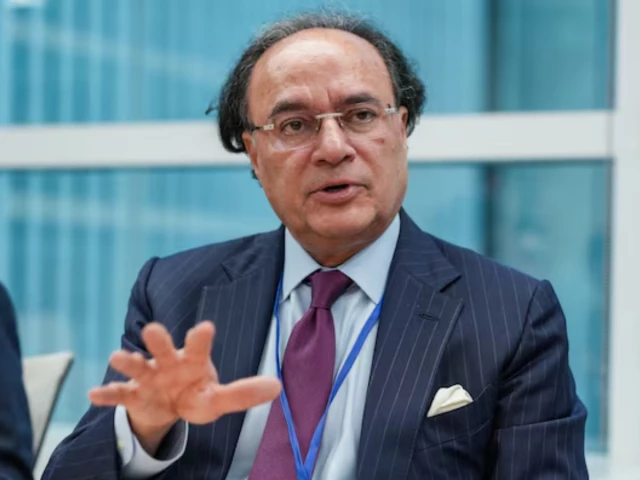
Believes that foreign exchange reserves will close at about $18.4b for this fiscal year
Pakistan Finance Minister Muhammad Aurangzeb. Photo: Reuters/ File
Finance Minister Muhammad Aurangzeb on Tuesday said that the newly approved tax administration model would rely on artificial intelligence and technology to minimise human intervention in dealings between tax officials and taxpayers, and now notices will be issued by it.
“Parliament has introduced a new tax administration operating model, and it has approved the new structure because it is a new engagement model between the tax administration and the taxpayers, where human intervention is going to be minimal. It is a very fundamental change because this is a model which is AI and technology-led, and notices will be issued by it,” Aurangzeb said while addressing the second edition of Pakistan Banking Summit 2026 in Karachi.
The finance minister said that the current account performance remains strong due to record remittance flows.
“We do expect our overall remittances for this year to close anywhere between $41-42 billion.”
He said that the last fiscal year was closed on a strong note across all matrices, starting with the fiscal side, a primary surplus, an all-time low fiscal deficit, a debt-to-GDP ratio well below 70 per cent, and GDP growth closing at 3.7 per cent on the back of a strong rebound in LSM.
Aurangzeb said we talk about the dip in exports, and indeed, from the good side, there was a dip, but that dip was concentrated on the food side, and value added, especially on the textile side, had continued to register year-on-year.
He believed that the foreign exchange reserves would close at about $18.4 billion for this fiscal year, which is higher than the earlier estimates.
“We started with the Eurobond and the most significant trade had been the Panda Bond because we had been at it for at least the last seven to eight years, and not tapping the second-largest, second-deepest capital market in the world had been a miss on our part.”
Speaking about the Pakistan Stock Exchange, he said that the activity drivers were more important than the PSX numbers and the number of investors, which had grown and, more importantly, the Gen Z investors were coming in as well as the corporate profitability, which had returned to double digits.
Referring to this year’s budget, he said that, for the first time, the budget was led by the Tax Policy Office, which had been moved to the finance division.
‘We focused on export-led growth, removing the advance tax, removing the super tax, low-cost subsidised financing, and continuing with the tariff regime.’
Aurangzeb thanked the prime minister and the cabinet in this regard.”We are also going to come up with a medium-term tax strategy,” he added.
Read More: FinMin says govt focused on broadening tax base, not burdening salaried class in budget
Aurangzeb said that access to finance and, therefore, the banking industry, would remain absolutely critical in terms of the government’s journey from stabilisation to sustainable growth. Increased lending to SMEs, exporters, agriculture, manufacturing, construction and IT industries were going to be mission-critical.
‘I think we have moved in the right direction, but there’s a long, long way to go.’
Speaking on privatisation, he said that PIA was now securely in the private sector’s hands and there were three DISCOS, whose roadshow was also complete as well as 28 institutions that had been handed over to the privatisation commission.
He also lauded PBA and sought suggestions from the summit.

Leave a Reply